What is on the chart?
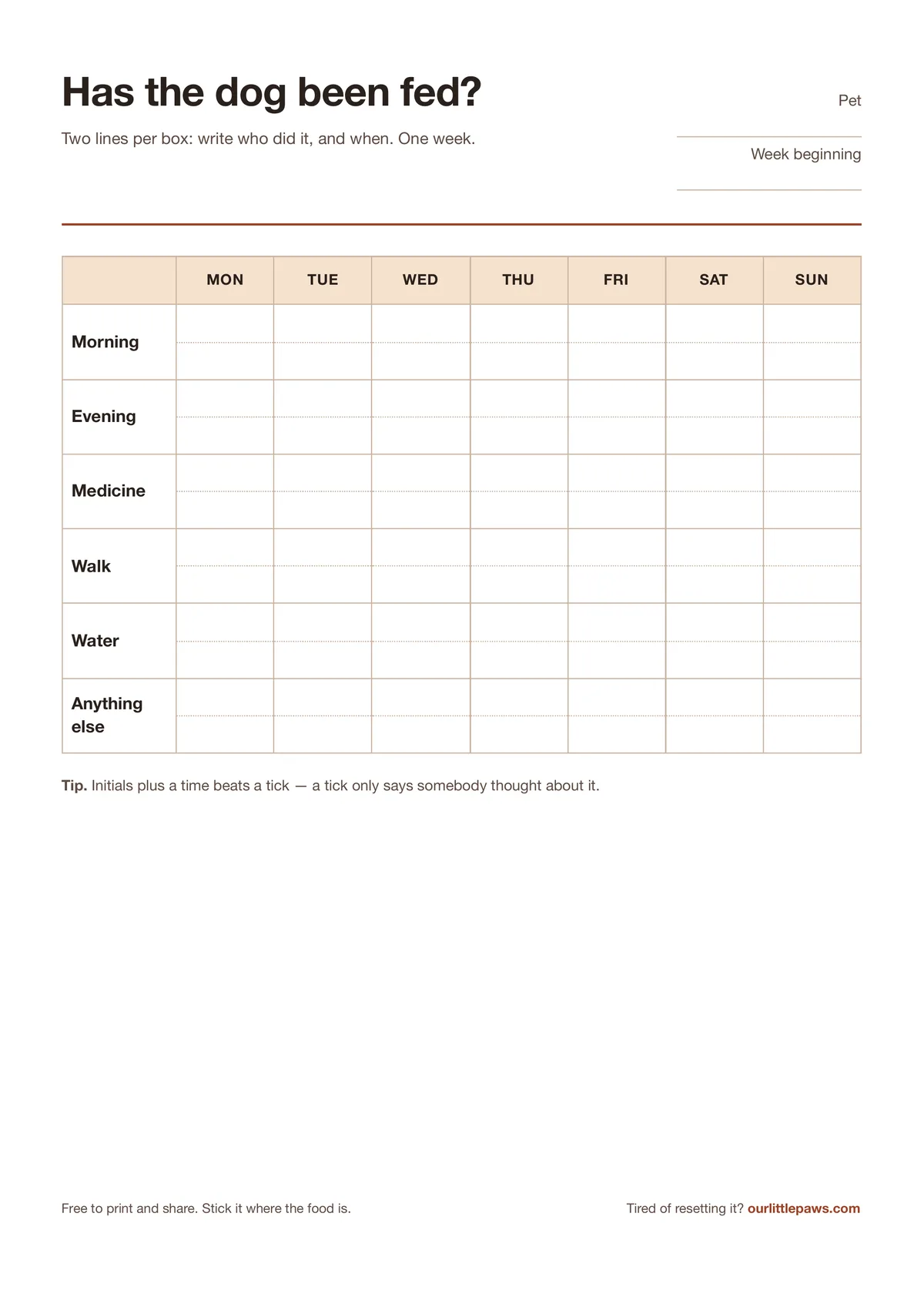
A week across the top, and six rows down the side: morning, evening, medicine, walk, water, and one spare row for whatever your animal needs that nobody else’s does. Every box has two writing lines, because one line invites a tick and two invite a name and a time.
Why write the time and not just tick it?
A tick only says that somebody thought about it. It does not say who, and it does not say when — which are exactly the two things the second person in the house needs. Initials and a time turn a shared chart into an answer instead of a hint.
A sample dog feeding schedule
How many meals a day, and when, depends on your dog’s age, size and whatever your vet or the food’s own packaging recommends — but if you are starting from nothing, here is a reasonable first draft. Use it as a starting point for the chart above, not a replacement for your vet’s advice.
| Life stage | Meals a day | A typical spread | Why |
|---|---|---|---|
| Puppy, 2–6 months | 4 | 7am, 11am, 3pm, 7pm | Small stomachs and fast growth — little and often works better than two big meals. |
| Puppy, 6–12 months | 3 | 7am, 1pm, 7pm | One meal usually drops out as growth slows, often around six months. |
| Adult, 1–7 years | 2 | 7am, 6pm | The standard once growth is done — evenly spaced, roughly 12 hours apart. |
| Senior, 7+ years | 2 (smaller) | 7am, 6pm | Same rhythm, often smaller portions — worth a specific chat with your vet. |
Two things matter more than the exact clock times: keeping the gap between meals roughly even, and sticking to whatever you land on for long enough that everyone in the house — and the dog — knows what to expect. Write your version into the chart above, or set it up once as a dog feeding schedule tracker in Our Little Paws under the Nutrition category, and the app logs every meal against it automatically, with who fed her and when.
Has the dog been fed?
If it is written down, yes. This chart works as a feeding schedule and a tracker in one: the rows across the top are the schedule, and the two lines in every box are the tracker — who did it, and when. For one animal in one household, paper does that job perfectly well. It is worth being honest about where it stops: paper cannot travel. If the person who fed her is at work, the chart on your fridge cannot tell you anything, and at the end of the week somebody has to put up a new one.
That is the point where a phone starts doing it better. In Our Little Paws you set the feeding schedule once — how often, up to six times a day, with a reminder if you want one, under the Nutrition category — and every time she is fed the app logs it automatically, with the time and who did it. No chart to reset, and everyone looking after the animal sees the same feeding schedule and tracker wherever they are.
Printing it
- It is A4. On US Letter, choose Fit to page and nothing will be cut off.
- Print it in black and white if you like — it is designed to survive that.
- One sheet is one week. Print a few at once and keep the spares in the drawer.
Next: you don’t need a fridge magnet — where paper stops working, and what replaces it.